The October 20, 2026 Draw at a Glance
Tuesday night's PCSO draws are in, and the headline is impossible to miss: the 6/58 Ultra Lotto jackpot sat at ₱420,158,396.49 when the balls dropped. That is a nine-figure prize pool, the kind that pulls in office pools from Cebu to Cagayan de Oro and turns sari-sari store counters into impromptu betting stations from 5 PM onward.
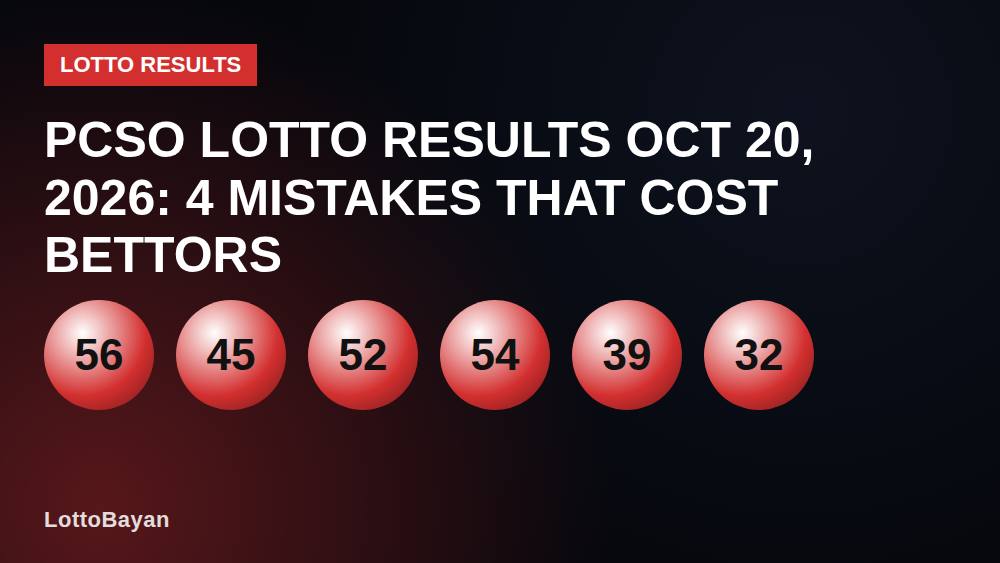
Here is the short version before we get into the mistakes. The 6/58 Ultra Lotto drew 56-45-52-54-39-32. The 6/49 Super Lotto drew 48-01-23-15-26-40 for a jackpot of ₱58,052,134.93. The 6/42 Lotto landed on 20-26-30-42-15-07 at the standard ₱10,000,000.00 minimum. And the 6D Lotto 9:00 PM draw came out 5-9-8-2-3-3 with a ₱1,258,126.88 prize.
The full breakdown, including jackpot figures and winner counts, is in the table above. Read it carefully — not because the numbers are complicated, but because the way people use them after the draw is where things go wrong.
Every Tuesday and Thursday, we watch the same patterns repeat in comments, group chats, and betting-station queues. So instead of another dry results recap, this article is built around the four mistakes we see most often in the 48 hours after a draw like this one. If you have ever found yourself checking results at 11 PM and wondering what to do next, this is for you.
| Game | Winning combination | Jackpot (PHP) |
|---|---|---|
| 6/58 Ultra Lotto | 56-45-52-54-39-32 | 420,158,396.49 |
| 6/49 Super Lotto | 48-01-23-15-26-40 | 58,052,134.93 |
| 6/42 Lotto | 20-26-30-42-15-07 | 10,000,000.00 |
| 6D Lotto 9:00 PM | 5-9-8-2-3-3 | 1,258,126.88 |
Mistake #1: Treating the 6/58 Result as a Pattern to Chase
Look at the Ultra Lotto combination again: 56-45-52-54-39-32. Five of the six numbers sit above 32. Four sit above 39. The spread is unusually top-heavy, and that is exactly why so many bettors will spend the next week loading up on 40s and 50s in their own tickets.
Here is the problem. The 6/58 game draws six balls from 58 without replacement. Every legal combination — from 01-02-03-04-05-06 to 53-54-55-56-57-58 — has exactly the same 1-in-40,475,358 chance on every single draw. The machine does not remember Tuesday. Balls do not get "hot" or "due." A top-heavy result on October 20 tells you nothing about October 22, October 24, or any draw in 2026/27.
What this mistake actually costs is measurable. Bettors who chase a pattern tend to:
- Buy more tickets than their budget allows, convinced they have spotted an edge
- Concentrate on a narrow band of numbers, which does not improve odds but does increase the chance of sharing a jackpot if they somehow win
- Abandon a fixed monthly lotto budget and dip into grocery or transport money
A smarter approach is to keep your play amount flat. If your ceiling is ₱100 per draw, it stays ₱100 whether the previous result was 56-45-52-54-39-32 or 01-02-03-04-05-06. Consistency protects your wallet; pattern-chasing erodes it one "sure thing" at a time.
Every combination has the same odds. The only variable you actually control is how much you spend getting there.
Mistake #2: Forgetting That the 6/49 and 6/42 Have Their Own Tails
The Ultra Lotto jackpot dominates every conversation, and that is precisely why the other draws get neglected. Look at the 6/49 Super Lotto result: 48-01-23-15-26-40 for ₱58,052,134.93. There is a genuine mix there — one low number (01), a cluster in the teens and twenties, and two high numbers (40, 48).
Meanwhile the 6/42 Lotto produced 20-26-30-42-15-07, an evenly distributed set that spans the whole board. Two very different shapes, drawn on the same night, from games with the same six-ball mechanics.
The mistake is buying a single ticket line and trying to make it work across all three games. The prize structures differ, the odds differ, and the jackpot rollover behaviour differs. The 6/42 carries a guaranteed ₱10,000,000.00 starting jackpot and rolls into the next draw if unclaimed. The 6/49 at ₱58.05 million is sitting at a level that suggests several consecutive draws without a winner. The 6/58 at ₱420.15 million is deep into a rollover streak — that kind of accumulation does not happen overnight.
Practical takeaway: check which games are actually rolling before you allocate your budget. A ₱20 line in a game with a guaranteed minimum jackpot behaves very differently from a ₱20 line in a game where the pot has been climbing for weeks. Neither is a better bet in pure odds terms, but knowing the state of each pot keeps you from spending on autopilot.
Also note the 6D Lotto result: 5-9-8-2-3-3 at ₱1,258,126.88. Note the repeated 3. In a digit game, repetition is entirely normal and expected. Bettors who avoid doubles because "they never come out" are working against basic probability — with six independent digits, repeated values occur constantly.
Mistake #3: Screenshotting Without Checking the Official Record
This one causes real damage, and it happens every single week. Someone sees a Facebook post at 9:45 PM claiming the 6/58 result is something it is not, screenshots it, and spends the next morning telling everyone they won. Or worse — they throw away a ticket that actually matched three or four numbers because a forwarded image said otherwise.
The October 20 draws are a good example of why you verify at the source. There are four separate draws on a Tuesday night, each with its own result, and the 6D runs at 9:00 PM while the lotto games follow their own schedule. Misinformation spreads fastest in exactly that window — after the balls drop but before everyone has refreshed an official page.
Our verification routine, which you can copy:
- Wait for the draw to be completed and the official result posted, not the live speculation in comment threads
- Compare your ticket's numbers against the official combination, digit by digit, starting from the highest number and working down — it forces you to actually look rather than skim
- Check the prize tier, not just the jackpot. Matching three or four numbers in 6/58 pays a fixed amount that has nothing to do with the ₱420 million headline
- Sign the back of your ticket before it leaves your sight. An unsigned winning ticket is a dispute waiting to happen
The 6/49 result of 48-01-23-15-26-40 is a useful test case. If you hold a ticket with 48, 23 and 40, you have three numbers — a modest prize, but a real one. Nobody should be losing that because they trusted a blurry screenshot instead of the official posting.
Mistake #4: Playing on Credit and Chasing the Loss
The ₱420,158,396.49 figure does something to people. It is large enough that it stops looking like money and starts looking like a solution — a way out of debt, a house, a business, a passport to a different life. That emotional weight is where the fourth and most expensive mistake begins.
We see it in the days after every massive rollover. Bettors who normally spend ₱50 spend ₱500. Bettors who play twice a week start playing daily. Bettors borrow from a lending app with a 5% monthly service fee to buy "one more line," convinced the big one is close.
Set hard rules before you play, not after:
- Fixed monthly cap. Decide the amount in advance and treat it as spent entertainment money, like a movie ticket. Once it is gone, it is gone until next month.
- Never borrow. No lending apps, no utang from a friend, no swiping the grocery budget. A lottery ticket bought on credit has a negative expected value twice over.
- Separate the games. If your cap is ₱200 for a Tuesday draw, split it deliberately across the games you actually want — say ₱100 on 6/58, ₱60 on 6/49, ₱40 on 6/42 — rather than adding the 6D on impulse at the counter.
- Log your spend. A simple notes file with the date and amount tells the truth your memory will not.
PCSO games are legal, regulated, and government-run — the proceeds fund health, education, and charity programmes. That is a genuine reason to feel fine about playing within your means. It is not a reason to treat the lotto as an investment strategy.
What the October 20 Results Actually Tell You
Strip away the noise and here is what a night like this one demonstrates. Four games, four completely different outcomes, all generated by independent random draws. The Ultra came out heavily weighted to high numbers, the Super Lotto came out wide, the 6/42 came out even, and the 6D threw a double. There is no unifying theme because there is no theme to find.
What is real and worth tracking: jackpot sizes and rollover status. The table above shows the 6/58 at ₱420.1 million, the 6/49 at ₱58.05 million, the 6/42 at its ₱10 million base, and the 6D at ₱1.26 million. Those figures will shift for the next draw, and knowing which pots are climbing is the only genuinely useful information a results page can give you.
The winner column, meanwhile, tells its own story. When a jackpot this large goes unclaimed, it rolls forward and the next draw gets bigger. That is the mechanism that built the ₱420 million in the first place — a long chain of draws where nobody matched all six. Understanding that chain is a far better use of your attention than hunting for patterns in the numbers themselves.
A Calmer Way to Play the Next Draw
If you are playing the Thursday draw or any draw later in 2026, here is the routine we recommend to readers who want to stay in the game without letting it run their finances.
Before you buy: set your cap, decide your game split, and write the numbers down in advance. Deciding at the counter means deciding with a queue behind you and a ₱420 million poster in front of you.
When you buy: check the ticket prints the numbers you asked for, keep it flat and undamaged, sign the back, and store it somewhere you will remember — not folded in a wallet next to a receipt.
After the draw: verify against the official result, check every prize tier and not just the jackpot, and if you have won anything above the smallest tier, follow the PCSO claim procedure with your ticket and valid ID. Small prizes can be claimed at authorised outlets; larger ones require a trip to the main office or a designated branch, and prizes above ₱10,000 are subject to the 20% final tax on winnings under the Tax Reform for Acceleration and Inclusion law.
After that: close the page and get on with your week. The draw is over. Nothing you do between now and the next one changes what already happened.
The October 20, 2026 result is now part of the record — 56-45-52-54-39-32, 48-01-23-15-26-40, 20-26-30-42-15-07, and 5-9-8-2-3-3. Somewhere out there, someone is holding a ticket worth more than they realise, and someone else is about to make one of the four mistakes above. The numbers are fixed. Your behaviour is the only part of this that is actually in your hands.
Frequently Asked Questions
What were the PCSO lotto results for October 20, 2026?
The 6/58 Ultra Lotto drew 56-45-52-54-39-32 with a ₱420,158,396.49 jackpot. The 6/49 Super Lotto drew 48-01-23-15-26-40 for ₱58,052,134.93. The 6/42 Lotto drew 20-26-30-42-15-07 at ₱10,000,000.00. The 6D Lotto 9:00 PM draw was 5-9-8-2-3-3 with a ₱1,258,126.88 prize.
Does a top-heavy result like 56-45-52-54-39-32 mean high numbers are more likely next time?
No. Each 6/58 combination has the same 1-in-40,475,358 chance on every draw, regardless of what came out before. The machine has no memory, so chasing high numbers after a high-heavy result does not improve your odds — it only narrows your selection and can increase the chance of sharing a jackpot.
How much tax is deducted from PCSO lotto winnings?
Prizes above ₱10,000 are subject to the 20% final tax on winnings under the TRAIN law, and PCSO deducts it before payout. Smaller prizes claimed at authorised outlets are paid at face value. Bring your signed ticket and a valid government ID when claiming.
Should I split my budget across all four games on a Tuesday draw?
Only if it fits a fixed cap you set in advance. A workable split for a ₱200 cap is ₱100 on 6/58, ₱60 on 6/49 and ₱40 on 6/42, with the 6D treated as optional. What matters is that the total stays flat regardless of how big the Ultra jackpot has grown.